By Prasad Karthik. Sources checked on 24 November 2026.
Filling topical gaps matters in AI search because AI uses what you explain, not what you only claim.
A page that names an offer but skips the details and the proof gives AI little to use.
By the end, you will know what a topical gap is and how to find one on your pages.
There Is No Secret to Writing for AI Search
The secret to writing for AI search is that there is no secret.
People often ask me for the trick. They want a keyword list, a magic word count or a target number of blog posts.
AI does not need you to stuff every possible keyword into your website.
AI does not need you to publish hundreds of articles on hundreds of topics.
What matters is how clearly and completely you explain the subject your website handles.
AI search means answer engines such as Google AI Overviews, Google AI Mode, ChatGPT, Perplexity and Gemini. They read pages, pick out facts and build one answer from many sources.
Getting your content used inside those answers is called Generative Engine Optimisation, or GEO.
I run GEO audits for businesses in Kerala and the Middle East. One problem shows up again and again. It is not a missing keyword. It is a topical gap.
What a Topical Gap Really Is
A topical gap is any piece of information your content needs but does not give.
Most people think a topical gap is a missing blog post. That is only one type.
A gap can also sit inside a page you already published. The topic is there, but the explanation is incomplete.
Three terms help here:
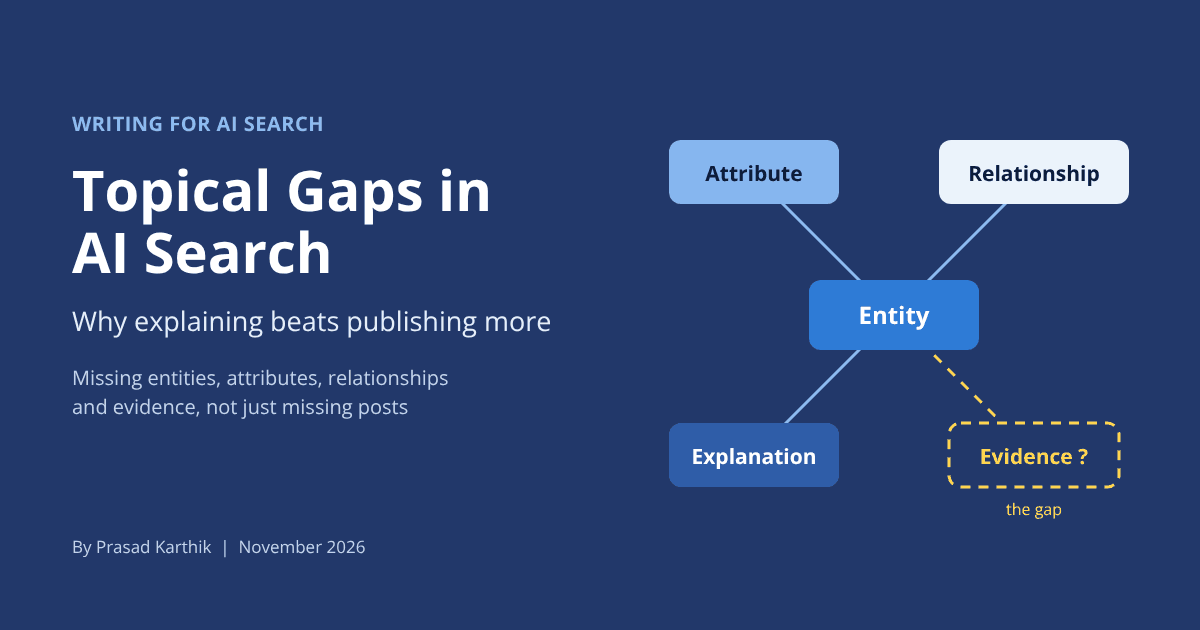
- An entity is a distinct thing that can be identified, such as a person, place, vehicle or activity.
- An attribute is a fact that describes an entity, such as its duration, price or qualification.
- A relationship is how two entities connect, such as “this guide leads this tour”.
With those three terms, a topical gap can take five forms.
Table 1. Five forms a topical gap can take
| Type of gap | What it means | Desert safari example |
|---|---|---|
| Missing entity | Something your page relies on but never introduces | “Expert guides” with no names or profiles |
| Missing attribute | A fact about an entity that is left out | Dune bashing with no duration or vehicle type |
| Missing relationship | How entities connect is never stated | Which guide drives which vehicle on which route |
| Missing explanation | A concept is named but never explained | “Dune bashing” used but never described |
| Missing supporting evidence | A claim has no proof behind it | “Expert” with no training, years or reviews |
A Dubai Desert Safari Example
Here is a sentence I see in some form on many tour websites in Dubai.
Example:
“Our expert guides will help you enjoy an unforgettable dune bashing experience in the Dubai desert.”
It sounds good. Now look at what it leaves out.
What the page never says about dune bashing
- What exactly is dune bashing?
- How does the experience work, step by step?
- What type of vehicles are used?
- How long does the activity last?
- What safety precautions are followed?
- Who is it suitable for, and who should skip it?
- What other activities are part of the safari?
These are basic questions about the activity being sold.
What the page never says about the guides
- Who are these guides?
- What qualifications and training do they have?
- How many years of desert driving experience do they have?
- What safety expertise do they bring?
- What do travellers who rode with them say?
The page claims the guides are experts. But where is the information that supports that claim?
Mapping the Sentence Into Entities, Attributes and Relationships
Once you map the sentence, the gaps become easy to see.
Table 2. The safari sentence mapped into entities, attributes and relationships
| Element | What it is | What the page should state |
|---|---|---|
| Dune bashing | An activity that needs explaining | What it is and how the ride works |
| Duration, vehicles, safety, suitability | Attributes of dune bashing | The actual values, such as minutes, vehicle type and age limits |
| Guides | Entities | Who they are, by name or profile |
| Qualifications, training, years, expertise | Attributes of the guides | Verifiable facts about each guide |
| Traveller reviews and documented trips | Supporting evidence | Proof behind the word “expert” |
| Vehicles, activities, desert location, people | Relationships | How they connect in one complete safari |
The vehicles, activities, locations and people all relate to each other. Those relationships explain the complete safari experience.
If your website does not explain these things, important information is missing.
These are topical gaps.
Why Topical Gaps Matter in AI Search
Topical gaps matter because AI search answers many smaller questions, not only the one the user typed.
One part of this is called query fan-out. The system turns one question into several related searches before it writes the answer.
On Google’s Search Off the Record podcast, Nikola Todorovic described fan-out as finding extra queries relevant to the user’s prompt.
Seer Interactive studied query fan-outs in Gemini 3. It found an average of 10.7 fan-out queries per prompt, and 95 percent had no measurable search volume.
That second number is the important one. Those hidden questions look like “how long does dune bashing take” or “is dune bashing safe for children”.
If your page does not answer them, another page will.
Surfer SEO also studied fan-outs. WordStream reported its finding. Pages ranking for fan-out queries were 161 percent more likely to be cited in AI Overviews.
Evidence matters as much as coverage. From my own testing, AI treats claims on your website as vendor statements. A claim backed by facts and proof gives AI something it can use with confidence.
This does not mean AI must find every detail before it uses a page. But unsupported claims and incomplete explanations give it less useful context.
What Most People Get Wrong
Most people treat a topical gap as a content calendar problem.
They see a competitor with 200 blog posts and decide they need 300.
- Publishing more instead of fixing what exists. Search Engine Journal has warned that publishing too much weakens semantic precision.
- Stuffing keywords instead of explaining entities. Repeating “Dubai desert safari” ten times adds no new fact.
- Making claims without proof. Words like expert, best and safe are claims. Training, years and reviews are evidence.
- Thinking a gap is only a missing topic. Often the topic is covered, but its attributes and relationships are not.
Here is how I explain it to my students. A new article cannot fix a weak explanation on an old page.
What I Do Before Planning New Content
Before I plan a single new article for a client, I audit the pages they already have. It is the first step in the work I do as a freelance SEO expert in Kerala.
I take each important page and ask four questions.
- Which entities does this page mention?
- Which attributes of those entities are missing?
- Are the relationships between them stated clearly?
- Is every claim backed by evidence a reader can check?
Example:
A wellness centre in Kerala writes: “Our experienced doctors offer authentic Panchakarma treatment.”
Who are the doctors? What qualifications do they hold? How many days does the treatment take? Who is it suitable for?
Each unanswered question is a topical gap on a page that already exists.
Fixing these gaps often takes a few paragraphs, a table or a short team profile. It rarely needs a new page.
The 12-month plan in my SEO content strategy services includes a full topical gap evaluation for this reason.
Inside Organic Growth Mastery, I walk my students through this exact audit before we build any topical map.
A Simple Topical Gap Checklist for Any Page
Use this checklist on your most important service page.
Table 3. A topical gap checklist for any page
| Check | What to look for |
|---|---|
| Main entity | Is the service or product explained in plain words? |
| Attributes | Are price, duration, process, location and suitability stated? |
| People | Do the people behind the service have names, roles and credentials? |
| Claims | Does every word like expert, best or safe have proof next to it? |
| Relationships | Does the page say who does what, where and with which tools? |
| Evidence | Are there reviews, numbers, photos or documented results? |
Then change the question you ask before planning content.
Stop asking first: “What new topics should we publish?”
Start asking: “Have we explained the entities, attributes and relationships in the topics we already cover?”
That is an important part of writing for AI search.
Frequently Asked Questions
What is a topical gap in AI search?
A topical gap is information your content needs but does not provide. It can be a missing entity, attribute, relationship, explanation or piece of supporting evidence.
Is a topical gap the same as a content gap?
Not exactly. A content gap usually means a missing page or keyword. A topical gap can exist inside a page that already covers the topic.
Do I need to publish more articles to fill topical gaps?
Usually not. Most gaps are filled by adding facts, explanations and evidence to pages you already have.
Does AI need every detail before it uses my page?
No. But unsupported claims and incomplete explanations give AI less useful context to work with.
How do I find topical gaps on my website?
Take one page and list its entities. Then check whether their attributes, relationships and supporting evidence are clearly stated.
Key Takeaway
- There is no secret to writing for AI search. Clear and complete explanation wins.
- A topical gap is not only a missing blog post.
- Gaps can be missing entities, attributes, relationships, explanations or evidence.
- AI search breaks one question into many smaller ones through query fan-out.
- Claims like “expert” need proof, such as training, years and traveller reviews.
- Fix the pages you already have before planning new topics.
Sources
- Search Engine Journal: Google explains query fan-out in AI search
- Seer Interactive: Initial research on Gemini 3 query fan-outs
- WordStream: Query fan-out, citing Surfer SEO’s fan-out study
- Search Engine Journal: Why publishing more content is making your SEO worse
- Search Engine Land: Semantic depth guide
I teach this entity, attribute and relationship audit inside Organic Growth Mastery, my advanced SEO course in Kerala. Want me to find the topical gaps on your own site? Book a 1:1 SEO consultation.