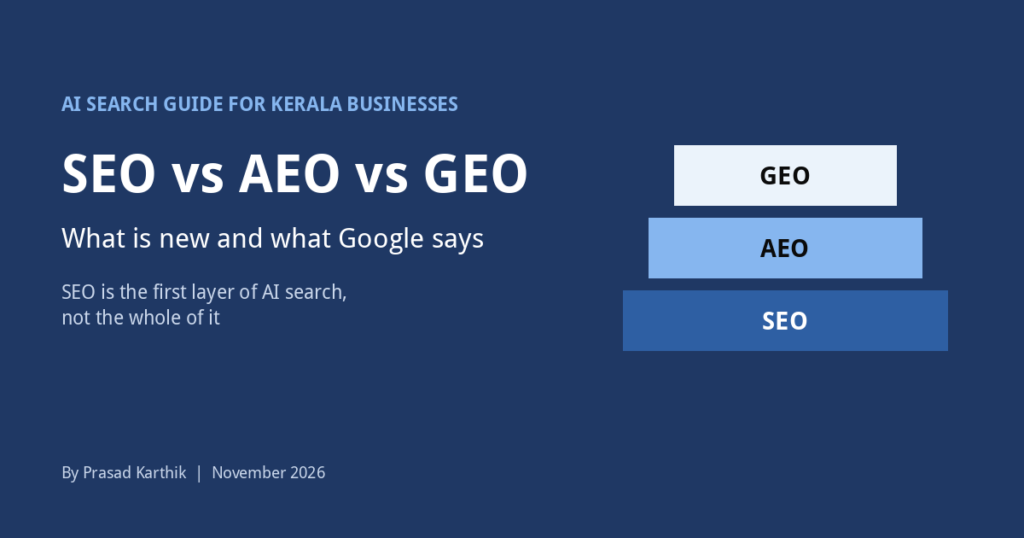

Search engines and AI answer engines favour pages that cost the least to find, read and trust.
A strong page can still lose. If it is slow to process or hard to quote, a plainer page wins.
This post explains why retrieval cost matters for Search Engine Optimisation, or SEO, and Answer Engine Optimisation, or AEO.
What Information Retrieval Cost Means
Information retrieval cost is the effort a search system spends to find, fetch, read, understand and trust a page.
Information retrieval is simply how a system finds the right content for a question. Every step uses time and computing power.
Think of a village library. One shelf is labelled and sorted. Another is a pile of books.
A librarian finds answers faster on the first shelf, so she looks there first.
Search engines behave the same way. They do not publish a cost score. But their limits and behaviour show that cost shapes what they read.
Example
Someone searches for a homestay in Munnar with a kitchen.
Page A opens with a slow slider and hides the amenities list at the bottom.
Page B opens with rooms, price per night and kitchen details.
Both are good homestays. Page B costs a machine far less to understand.
Why Cost Comes Before Quality
Search systems think about cost before quality, because every page they process costs money.
Reading pages and running ranking systems uses computing power. Google already has results that satisfy most searchers.
To replace one of those results, Google must test your page on real users. A failed test loses clicks. So a page that is cheap to understand is an easier page to test.
I tell my students to think of it as a budget. The less a page asks of the system, the more likely it gets a fair test.
This is why a good page can sit unseen while a simpler competitor holds the top spot.
Where Cost Is Paid in Traditional SEO
In classic search, cost is paid in two places: the size of the file and the position of your answer.
Googlebot is the program that reads web pages for Google. Its documentation says it crawls the first 2 megabytes of an HTML file for Search.
HTML is the code behind a page. Content past the cutoff may be ignored.
The limit applies to uncompressed data and to each file separately. Google also says the limit is not set in stone and may change.
Most small business pages sit far below 2 megabytes. But heavy page builders, inline scripts and long menus add code before your content begins.
Putting the main answer early costs nothing. It also helps any system that reads only the start of a page.
Example
A saree shop in Thrissur built its category page with a heavy page builder.
The kasavu saree price list sits far down, below sliders and offer banners.
Moving the price list and fabric details to the top makes the page cheaper to read and easier to judge.
How to Lower Cost for Google
Lowering cost is mostly housekeeping. Five changes cover most sites.
- Keep the HTML lean. Open Chrome DevTools, go to the Network tab and read the size on the Doc row.
- Put the main content early. Menus, sliders and pop ups come after the answer.
- Give each intent one page. Merge near copies so Google does not have to choose between them.
- Keep facts consistent across your site and your Google Business Profile. This is the free listing that appears on Google Maps.
- Use clear headings so each section states its own topic.
Example
A caterer in Kozhikode has 80 pages that differ only by locality name.
Google must choose between near copies, and none of them stands out.
After merging them into 30 distinct pages, each page has one clear job.
Why AEO Is a Cost Game Too
Answer Engine Optimisation is shaping content so AI systems can pull a passage from it, trust it and cite it.
AI answers start with fan-out. Google says AI Overviews and AI Mode may use a technique called query fan-out. It turns one search into many related searches.
Each related search retrieves pieces of pages. The system then builds one answer from the best pieces.
This is called Retrieval Augmented Generation, or RAG. The AI searches first and then writes.
Only part of a page survives. In a DEJAN AI study of Gemini grounding, the median source contributed about 377 words.
This is third party data. Google has not published its own figures.
The same study found that coverage falls as pages grow. About 61 percent of pages under 1,000 words was used. For pages over 3,000 words, it was about 13 percent.
Rankings Still Matter, But Not Enough
Ranking helps, but it no longer guarantees a citation.
Ahrefs studied 1.9 million citations in July 2025. About 76 percent of the cited pages ranked in the top 10.
A larger Ahrefs study in 2026 covered 4 million cited URLs. Only about 38 percent ranked in the top 10.
One likely reason is query fan-out. Pages can be retrieved for related questions, not only for the original query. That is my reading, not a proven cause.
Passage level selection points the same way. One analysis of AI Mode citations showed Google linking to a highlighted passage of about 117 words.
So the goal has two steps. Win the page in search. Then make the passage easy to lift.
How to Lower Cost for AI Answers
Make every section a passage that a machine can lift without the rest of the page.
- Open each section with the direct answer in one sentence.
- Give each section one idea and a clear heading, ideally written as a question.
- Write sentences that stand alone. Avoid phrases like as mentioned above.
- Use short tables for prices and comparisons.
- State facts as entity, attribute and value.
An entity is a clearly identifiable thing, such as a hospital service. An attribute is a property of it, such as cost. A value is the actual detail, such as a price range.
| Before: costly to lift | After: cheap to lift |
|---|---|
| Our hospital offers excellent knee replacement with experienced surgeons and a comfortable stay. | Total knee replacement at our Kochi hospital costs Rs 2.5 to 4 lakh, depending on the implant. Most patients stay 4 to 5 days. |
These figures are illustrations. Use details you can verify.
HubSpot’s 2026 AEO material says clear headings and direct answers correlate with higher citation frequency. That is correlation, not proof.
Cost Is Not Only Code: The Cost of Trust
A page is also costly when a machine cannot tell whether to believe it.
Systems can compare the values on your page with values elsewhere. If your prices or timings disagree across your site and listings, the system has more work to do.
Clean, consistent facts lower that work. They also make your page safer to quote.
Example
A dental clinic in Kochi shows one root canal price on its service page. A blog post shows another.
Its Google Business Profile shows a third version.
A machine cannot tell which one is right, so it may quote a competitor with one clear figure.
Fix this with one source of truth. Keep a single sheet of prices, timings and service details, and update every page and profile from it.
A Ten Minute Cost Audit You Can Run Today
You can check any page in ten minutes with free tools.
| Check | How to do it | A good result |
|---|---|---|
| HTML size | Chrome DevTools, Network tab, read the Doc row | Far below 2 megabytes |
| Answer position | Scroll to find where the main answer first appears | Within the first screen or two |
| Section clarity | Read the first sentence under each heading | Each one answers the heading |
| Near copies | Search your own site for the main phrase | One page per intent |
| Fact consistency | Compare prices and timings across page, profile and listings | Identical everywhere |
| AI test | Ask an AI search tool the page’s main question | Your page appears or is cited |
Do this before you rewrite a word. Many pages improve more from fixing position and clarity than from adding content.
What Most People Get Wrong
These are the mistakes I see most often.
- Believing longer pages win. In the DEJAN AI data, selected words stayed flat while coverage dropped as pages grew.
- Thinking more pages mean more authority. Near copies raise cost and compete with each other.
- Treating schema as a cure. Schema is code that labels what a page contains. It helps machines read question and answer pairs, but it cannot fix a vague answer.
- Splitting SEO and AEO into two jobs. They are one cost problem seen at two stages.
- Ignoring page weight. A heavy builder can push your best content out of view.
What I Do With My Clients
Having worked with businesses across Kerala and the Middle East, I check cost before I touch the words.
- Open the page in Chrome DevTools and note the HTML size on the Doc row.
- Check whether the main answer sits near the top.
- List the questions the page should answer, including related ones.
- Give each question a heading and open with the direct answer.
- Label key facts as entity, attribute and value.
- Ask an AI tool the main question and see whether it cites the page.
- Track clicks and queries in Google Search Console, which is Google’s free tool for seeing how your site performs.
Example
An Alappuzha houseboat operator moves the overnight cruise price above the photo slider.
It adds a table showing price per night for each boat type.
Each section now answers one question in its first sentence.
When I started teaching Generative Engine Optimisation, or GEO, to marketers in India, most had never thought about cost. GEO means getting your content cited inside AI answers. Inside Organic Growth Mastery, I teach this process with live website examples in my advanced SEO course in Kerala.
Frequently Asked Questions
Q: Is information retrieval cost a Google ranking factor?
A: Google has not published a retrieval cost score. I use it as a model. Limits such as the 2 megabyte HTML cutoff show that cost shapes what Google reads.
Q: Does a longer page hurt AEO?
A: Not by itself. But in the DEJAN AI study, a smaller share of long pages was used. Keep each section clear enough to stand alone.
Q: How big can my HTML file be?
A: Google documents 2 megabytes per HTML file for Search. Most pages are far smaller. Check yours in Chrome DevTools.
Q: Are SEO and AEO different jobs?
A: They share one foundation. Google’s AI features documentation says the same technical requirements as regular Search apply.
Q: Does schema lower retrieval cost?
A: It can help machines read labelled content such as question and answer pairs. It does not fix a vague or buried answer.
Q: How long before I see results?
A: Plan for weeks to months. Google needs time to recrawl and gather data. AI answers can also change from one run to the next.
Key Takeaway
- Search systems think about cost before quality.
- Cost is the effort to find, fetch, read, understand and trust a page.
- Google documents a 2 megabyte HTML limit for Search, so lean code and early answers matter.
- AI answers use only part of a page, so every section must stand alone.
- Top 10 rankings alone no longer predict AI citations.
- Open sections with the direct answer and state facts as entity, attribute and value.
- SEO and AEO are one cost problem seen at two stages.
If you want help applying this to your own website, talk to an experienced freelance SEO expert in Kerala.
About the Author
Prasad Karthik is an SEO trainer, consultant, and Generative Engine Optimisation (GEO) strategist based in Trivandrum, Kerala. He is the founder of Organic Growth Mastery, an advanced AI-first, content-led SEO course built for serious practitioners.
With hands-on experience working with businesses across Kerala and the Middle East, Prasad bridges the gap between SEO strategy and real-world execution. He is one of the few SEO educators in India actively training marketers in Generative Engine Optimisation: the discipline of making content visible inside AI-generated answers on Google, ChatGPT, Perplexity, and beyond.
If you want to go deeper on this, I cover the full system inside Organic Growth Mastery, my advanced AI-first SEO course. Check it out at organicgrowthmastery.com.