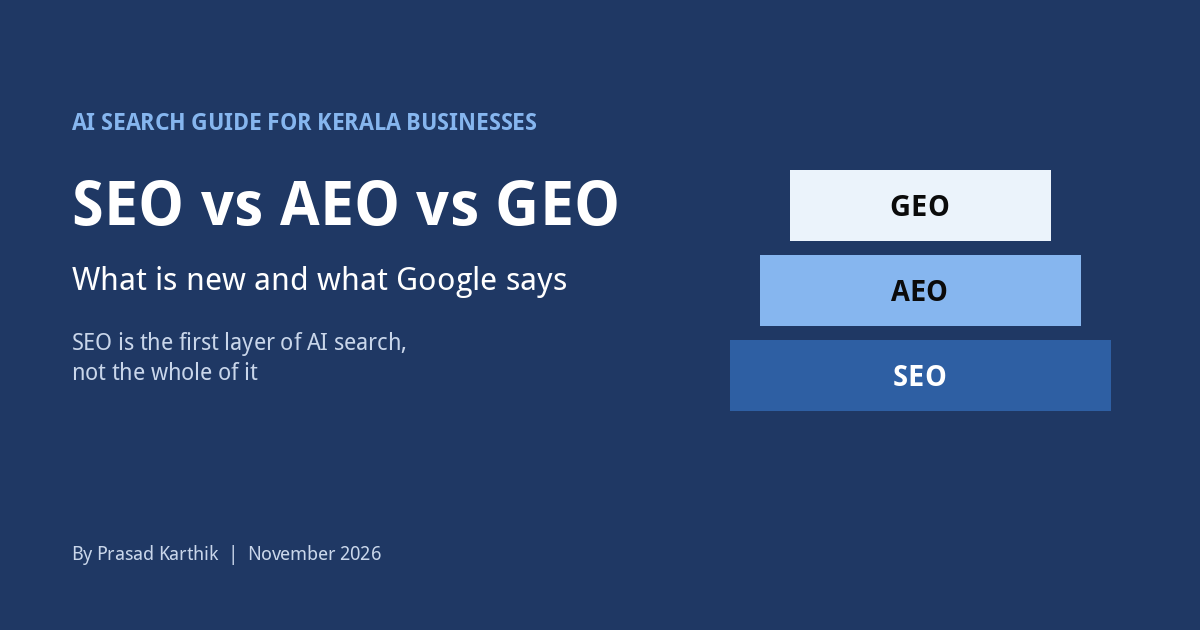
By Prasad Karthik. Google guidance checked on 21 November 2026.
Search engine optimisation is the first layer of AI search, not the whole of it.
Google says its generative answers still run on search basics, but those answers also need evidence from other websites.
This guide explains the three terms, what Google says, and how I approach AI search for Kerala businesses.
What SEO, AEO and GEO Mean in Plain Words
All three terms describe ways to make your content show up when someone looks for an answer.
Search Engine Optimisation, or SEO, is the work of helping your pages appear in Google’s normal results. It covers content, site structure, links and business details.
Answer Engine Optimisation, or AEO, is shaping content so a search tool can lift a short, direct answer from it. The term grew with voice assistants and with featured snippets, the highlighted answer boxes above some Google results.
Google now has two Artificial Intelligence, or AI, features in Search. AI Overviews are short summaries at the top of some results, and AI Mode is a separate chat-style search.
Generative Engine Optimisation, or GEO, is getting your content cited inside answers that AI tools write. Those tools include ChatGPT, Perplexity and AI Mode.
Table 1. SEO, AEO and GEO side by side.
| Term | Where you show up | What success looks like |
|---|---|---|
| SEO | Google’s normal list of results | Someone clicks through to your page |
| AEO | Featured snippets, voice answers and other direct answers | Your text is chosen as the answer |
| GEO | AI Overviews, AI Mode, ChatGPT and Perplexity | Your page is cited or your business is named |
SEO, AEO and GEO: three scoreboards, one foundation
Each term measures a different place you can show up. All three depend on the same indexed, useful page.
Figure 1. How the three terms relate, based on Google’s guide updated on 10 July 2026, which treats AI search optimisation as SEO.
What Google Says About AEO and GEO
Google’s answer is short: for its own search, AEO and GEO are still SEO.
Google publishes a guide called Optimizing your website for generative AI features on Google Search. Its last update was on 10 July 2026.
The guide names AEO and GEO directly. It says that, from Google’s side, optimising for AI search is still SEO.
A separate Google page says there are no extra requirements to appear in AI Overviews or AI Mode. The page needs to be indexed and allowed to show a text snippet.
Indexed means Google has stored the page in its library of web pages. Google lists five things you can ignore for its search:
- llms.txt files and other special AI files. Google Search does not use them.
- Breaking pages into small chunks for AI. Google says there is no ideal page length.
- Rewriting content in special AI phrasing or adding extra long-tail keywords.
- Chasing fake mentions of your brand across the web.
- Adding special structured data only for AI. Structured data still helps with rich results.
What Google does ask for is original content with first-hand or expert views. It also wants a clean technical setup and accurate business details.
What Is Actually New in AI Search
Three things are new: how Google builds AI answers, the languages it answers in, and how you measure it.
Both AI Overviews and AI Mode can use query fan-out. Google runs several related searches across subtopics before it writes one answer.
Example: Someone asks for a two-day family trip plan in Munnar. Google may search hotels, tea estate visits, weather and road conditions, then combine the results.
How query fan-out builds one AI answer
One question becomes several searches. Your page can be cited for one part of the answer.
Figure 2. Based on Google’s AI features page, which says both features may use query fan-out.
So one page can be cited for a small part of a big question. A clear answer to one sub-question matters more than before.
Language is the second change. Google added Malayalam to AI Mode in October 2025, along with six other Indian languages.
Measurement is the third. On 3 June 2026, Google announced a Generative AI performance report in Search Console, its free tool for site owners.
By the end of August 2026, the report had reached sites worldwide. It shows impressions, pages, countries and devices for AI Overviews and AI Mode.
An impression is one time your page was shown. The report shows no clicks and no search queries, so treat it as a visibility count.
Why I Treat SEO as the First Layer of AI Search
In my view, SEO gets you into the pool of pages AI tools can find. Evidence decides who gets quoted.
Google’s statement covers Google Search. ChatGPT, Claude and Perplexity are separate products, and in my research they behave differently.
Based on my research, ChatGPT and Claude lean mostly on earned media when they answer. Earned media is what other sites, reviews, news and forums say about you.
Gemini and Google’s AI features use a mix of earned media and owned media. Owned media is your own website and profiles.
AI search needs evidence. Claims on your own website read like vendor data, because the seller wrote them.
In traditional SEO, those same claims still count. They help on-page relevance and the ranking of your own pages.
Example: A Kochi agency calls itself the best in Kerala on its own website, and Google can still rank that page. An AI answer looks for reviews, client mentions and press that agree.
This is my observation from my own checks, not a published rule from any of these companies. Test it on your own brand before you plan around it.
How I see the layers of AI search
SEO is the base layer. Each layer above it adds what AI answers look for before they quote you.
Figure 3. Prasad Karthik’s working model of AI search, November 2026. It reflects his own research, not a published rule from Google or any AI company.
How I Approach AI Search Differently
My approach to AI search starts with the problems people are trying to solve, not with keyword lists.
Apart from collecting keywords, we find the problems each person is trying to solve. Deep audience research shows the concerns they search for.
Those problems then shape the content strategy. Each page answers a real concern, in the words people use.
We also build an external topical map. A topical map is a plan of the topics to cover and how they connect, and ours includes other websites.
This builds entity clarity, meaning AI tools clearly understand who you are and what you do. It also builds strong co-occurrence, where your name keeps appearing beside the right topics.
After we started practising AEO and GEO, we changed how we write.
- Atomic paragraphs: each paragraph makes one complete point that still makes sense when quoted alone.
- Atomic sentences: each sentence carries one fact or one claim.
- Information gain: we write what other pages miss, such as a local detail, a number or a first-hand lesson.
Topical coverage on its own is not enough for AI search and GEO. Covering a topic gets you considered, and adding something new gets you quoted.
How AI Answers Change Clicks From Google
AI answers can reduce clicks to websites, even when your page ranks first.
Ahrefs, an SEO tool company, studied 300,000 keywords using Search Console data. It compared December 2023 with December 2025.
Where an AI Overview appeared, the top page had a 58% lower average click-through rate. An earlier Ahrefs study, from April 2025, found 34.5%.
Click-through rate is the share of people who see your result and click it.
Google tells a different story. It says clicks from results pages with AI Overviews are higher quality, meaning people spend more time on the site.
Both can be true. Fewer people may click, but those who do may be closer to buying.
Example: An Ayurveda clinic in Kovalam may lose clicks on a general question about what panchakarma is. It can still get calls from people asking where to book a treatment.
This is why I ask business owners to track enquiries, not only traffic. Calls, WhatsApp messages and bookings tell you more than visits.
SEO vs AEO vs GEO for One Kerala Business
One business can show up in all three places, for three different kinds of search.
Take a houseboat operator in Alappuzha. Here is how each term plays out for the same business.
Table 2. Three searches, one houseboat business in Alappuzha.
| Search | Type | What the business needs |
|---|---|---|
| houseboat booking Alappuzha | SEO | A booking page that ranks in normal results |
| how long is a houseboat cruise in Alleppey | AEO | A clear answer of two or three sentences on the page |
| plan a two-day backwater trip for five people under ₹30,000 | GEO | Clear prices, routes, timings and reviews that AI tools can cite |
The same page and the same facts serve all three. The difference is the shape of the question, not a new kind of work.
A Google Business Profile is the free listing that shows a business on Google Maps and in local search. Google’s guide says these profiles can help local businesses appear in AI answers.
So the houseboat operator should keep its prices, photos and phone number the same on its profile and its website. AI tools trust facts that agree across sources.
Where the Term GEO Came From
GEO started as a research term, not a Google term.
Researchers from Princeton University, Georgia Tech, the Allen Institute for AI and IIT Delhi coined it. Their paper was first shared in November 2023.
It was later presented at KDD 2024, a major data science conference. So the field has an Indian research thread from the start.
The team tested changes such as adding statistics, quotations and source citations. They reported that GEO could raise visibility in AI answers by up to 40%.
They tested on Perplexity and on their own engine modelled on Bing Chat, not on Google.
Treat the 40% with care. A 2026 review of GEO research calls it a best case on one measure, not a general result.
Still, the core lesson matches Google’s advice. Clear facts, real numbers and named sources make content easier to cite.
When I teach GEO, I start from this point. Make your page the most useful, most quotable source on one question, then let the systems find it.
What Most People Get Wrong About AEO and GEO
Most of the confusion comes from people selling AEO and GEO as new services.
Myth: You need an llms.txt file to appear in Google’s AI answers.
Reality: Google says its search does not use llms.txt. Other AI tools may read it, but it does not help Google visibility.
Myth: GEO replaces SEO.
Reality: Google says its AI features rely on its core ranking systems. In my view, SEO is the first layer and evidence comes next.
Myth: You must rewrite every page for robots.
Reality: Google says AI systems understand synonyms and meaning. Write clearly for people, and answer the real question early.
Myth: SEO is dead.
Reality: In my SEO salary in Kerala survey from November 2026, about 87% of people who answered still work in SEO.
Myth: Covering every topic is enough for AI search.
Reality: In my experience, topical coverage alone is not enough. AI tools quote pages that add something others miss.
If someone sells you GEO without checking your indexing first, ask them why.
What I Recommend for Kerala Businesses
Do the SEO basics well, then make your facts easy for AI tools to quote.
This is the order I follow as a freelance SEO expert in Kerala.
- Check that your key pages are indexed in Search Console. A page Google cannot index cannot appear in AI answers.
- Answer the main question in the first two sentences of each section. Keep that answer short and specific.
- Add real numbers, dates and named sources. Prices, timings and distances get quoted more than vague claims.
- Keep your Google Business Profile accurate, with the same phone number, address and hours as your website.
- Write from first-hand experience. Google’s guide favours original views over summaries of other pages.
- Earn real mentions on other sites: reviews, local news, partner pages and directories. Google warns that fake mentions do not help.
- Publish key pages in Malayalam when your customers search in Malayalam.
Inside Organic Growth Mastery, my advanced SEO course in Kerala, I teach SEO first, then AEO and GEO on top.
SEO is the first layer, and AI search adds evidence, entities and atomic writing on top of it.
I have also written about how to add your business to ChatGPT and information retrieval cost.
How to Check Whether AI Search Shows Your Business
You can check AI visibility with one free Google report and a simple monthly test.
In Search Console, open Performance, then Search results, then Generative AI. It lists the pages that appeared in AI Overviews and AI Mode.
The data starts on 18 May 2026, and it shows impressions, not clicks. Compare those pages with your enquiries for the same weeks. If a key page drops out, check it first.
For ChatGPT and Perplexity, run a fixed set of questions each month. Use the questions your customers really ask, in English and Malayalam.
Example: A coaching centre in Kochi asks the same eight questions on the first Monday of each month. It notes whether its name or website appears.
Write down the date and save a screenshot. AI answers change often, so one check proves little.
Avoid tools that claim to show internal Google AI data. Google’s guide warns that third-party tools do not have that access.
FAQ: SEO vs AEO vs GEO
Q: What is the difference between SEO, AEO and GEO?
A: SEO helps pages rank in normal results. AEO shapes content into direct answers. GEO aims for citations inside answers that AI tools write.
Q: Does Google support AEO and GEO?
A: Google’s guide, updated in July 2026, says optimising for its AI features is still SEO. It needs no special files or markup.
Q: Is GEO only for big brands?
A: No. A small Kerala business with clear facts and an accurate Google Business Profile can be named in AI answers.
Q: Is SEO enough for AI search?
A: No. SEO is the first layer. AI answers also need evidence from other sites and content that adds something new.
Q: Does AI Mode work in Malayalam?
A: Yes. Google added Malayalam to AI Mode in October 2025.
Q: How do I know if my site appears in AI Overviews?
A: Open the Generative AI report in Search Console. It shows impressions from AI Overviews and AI Mode since 18 May 2026.
Key Takeaway
- SEO is the first layer of AI search. Evidence from other sites decides who gets quoted.
- In my research, ChatGPT and Claude lean on earned media, while Gemini mixes owned and earned media.
- Google’s July 2026 guide says optimising for its AI features is still SEO.
- Google Search does not use llms.txt, and it needs no special AI markup.
- AI Mode has worked in Malayalam since October 2025, so Kerala businesses should think in both languages.
- Ahrefs found AI Overviews went with a 58% lower click-through rate for the top page, so track enquiries too.
- Search Console now shows AI Overviews and AI Mode impressions, with data from 18 May 2026.
Sources
- Google Search Central: Optimizing your website for generative AI features on Google Search, updated 10 July 2026
- Google Search Central: AI features and your website, updated 10 December 2025
- Google Search Central Blog: Introducing Search Generative AI performance reports in Search Console, 3 June 2026
- Google India Blog: New languages in AI Mode and Search Live, October 2025
- Ahrefs: Update, AI Overviews reduce clicks by 58%, 4 February 2026
- Aggarwal and others: GEO, Generative Engine Optimization, arXiv and KDD 2024
- Critical survey of Generative Engine Optimization research, 2023 to 2026, arXiv
I cover the full AI search system inside Organic Growth Mastery, my advanced AI-first SEO course. The course builds skills and does not offer placement. Read about the advanced SEO course in Kerala.