
By Prasad Karthik. Survey data from 20 to 21 November 2026. I plan to update this post after my May 2027 survey.
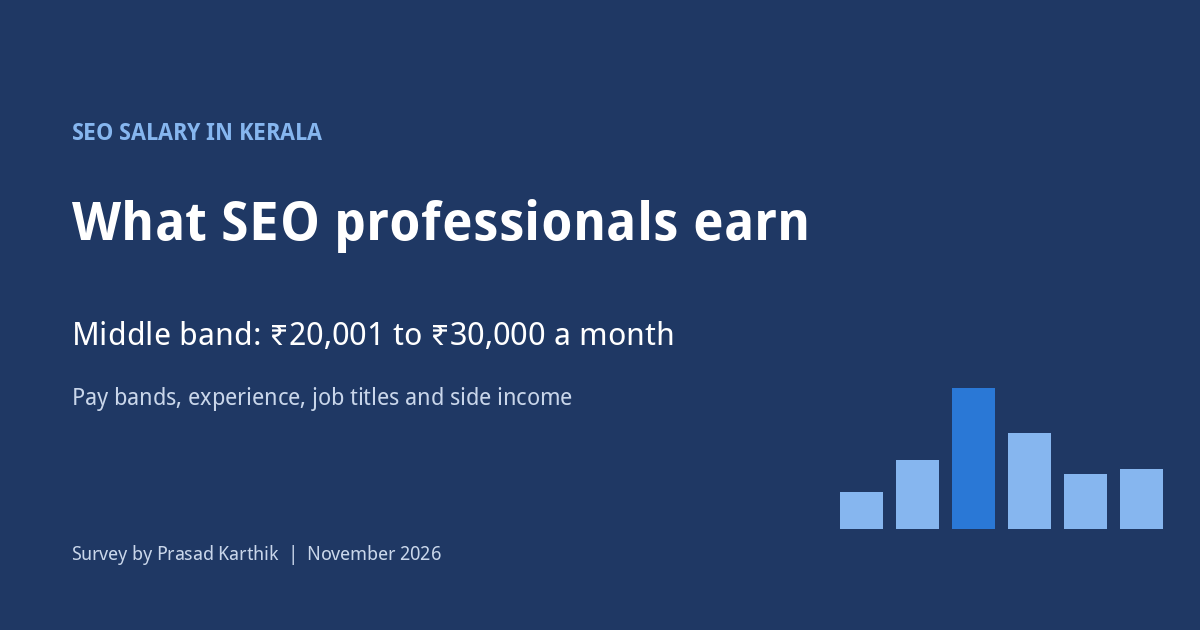
In my November 2026 survey, the middle Search Engine Optimisation, or SEO, salary is ₹20,001 to ₹30,000 a month.
SEO is not dead, and about 87% of the people who answered still work in it.
This post shows the pay spread, what moves pay, and what one survey cannot prove.
The Middle SEO Salary Band Is ₹20,001 to ₹30,000 a Month
The middle SEO salary in my survey is ₹20,001 to ₹30,000 a month.
That is a pay band, a salary range that a person picks instead of typing an exact figure. The median is the middle answer when you line everyone up from lowest pay to highest.
The form offered six bands, from up to ₹10,000 to above ₹50,000. The largest group, about 31%, sits in the middle band.
About 54% report ₹30,000 a month or less, and 13% report more than ₹50,000.
Monthly salary bands reported by working SEO professionals
More than half report ₹30,000 a month or less. The darker column holds the middle respondent.
| Band | Share |
|---|---|
| Up to ₹10,000 | 8% |
| ₹10,001 to ₹20,000 | 15% |
| ₹20,001 to ₹30,000 | 31% |
| ₹30,001 to ₹40,000 | 21% |
| ₹40,001 to ₹50,000 | 12% |
| Above ₹50,000 | 13% |
Figure 1. Share of respondents who work in SEO and reported a monthly salary band, November 2026. Shares are rounded to whole numbers. Source: SEO professionals survey by Prasad Karthik, anonymous Google Form. Self-selected respondents.
The top band has no upper limit, so I do not report an average. I round every percentage to a whole number.
Example: A person who earns ₹28,000 a month picks the ₹20,001 to ₹30,000 band. So does a person who earns ₹21,000.
The form asked for monthly salary from SEO work. Some people may have added side income, such as freelance pay.
Who Answered the Survey
I work from Trivandrum as a freelance SEO expert in Kerala, with businesses across Kerala and the Middle East. For this survey, I approached SEO professionals in Kerala with a short anonymous questionnaire.
I built the form in Google Forms, a free Google tool for online surveys. The answers I used arrived in about a day, on 20 and 21 November 2026.
It asked about job status, experience, job title, work mode, clients, side income and monthly pay. It collected no names, employers or contact details.
Table 1. Who answered. Every share except the first is of people who work in SEO.
| Group | Share |
|---|---|
| Work as an SEO professional now | 87% |
| Have two years of experience or less | 55% |
| Work remotely | 49% |
| Work onsite | 42% |
| Work in a hybrid setup | 9% |
| Have international clients | 70% |
| Earn side income | 53% |
Titles vary. About 28% are Specialists, 21% are Analysts and 17% are Executives. The rest hold other titles, such as trainee, senior executive or team lead.
The other 13% said they do not work as an SEO professional now. The form did not ask what they do instead.
Is SEO Dead? What the Survey Shows
No. Many people say SEO is dead, but the people in my survey still work and earn in it.
- About 87% of the people who answered still work as SEO professionals.
- Pay reaches above ₹50,000 a month, and about 25% report more than ₹40,000.
- About 53% also earn on the side from freelance or other SEO work.
These figures show who is still in the field, not who left. People who left SEO may not have answered.
Outside Kerala, the picture is mixed. In the United States, entry-level job postings across all fields are down about 35% since January 2023. Search Engine Journal, an SEO news site, quoted that Revelio Labs figure on 3 June 2026.
It does not describe SEO or Kerala. I treat it as a caution for beginners, not as proof that SEO is dying.
My view: SEO is changing, not dying. Artificial Intelligence, or AI, now writes answers on some Google results pages. A beginner needs to understand classic SEO and AI search.
What Sits Above ₹50,000 a Month
The top band is above ₹50,000 a month, and the form gave it no upper limit. About 13% of the people who gave a pay band chose it.
Some people in that band told me personally that they earn ₹2 lakh a month or more. A lakh is ₹100,000, so that is ₹200,000 a month.
These are personal accounts, not survey results, so do not read them as an average or a promise.
Almost everyone in the top band also reports side income, such as freelance work. So I cannot say how much of a high figure is salary.
Example: Imagine someone on a ₹45,000 salary who adds ₹30,000 from freelance clients. They might report ₹75,000, which falls in the top band.
The top band is a small group, so read this as a pattern worth testing, not as a rule. If you read one number from this post, read the middle band, not the top one.
How SEO Pay Moves With Experience
Pay was higher among people with more experience, but the groups overlap a lot.
Table 2. Middle pay band by years of experience. Shares are rounded, so they may not add to 100.
| Experience in SEO | Share of respondents | Middle pay band |
|---|---|---|
| Less than 1 year | 13% | ₹10,001 to ₹20,000 |
| 1 to 2 years | 42% | ₹20,001 to ₹30,000 |
| 3 to 5 years | 40% | About ₹30,000, on the line between two bands |
| 6 to 10 years | 6% | ₹40,001 to ₹50,000 |
Most people with under one year of experience report ₹20,000 a month or less.
Everyone in the 6 to 10 year group reports more than ₹40,000, but that group is very small. Nobody in my survey has more than 10 years of experience, so it says little about senior pay.
A rank correlation is a score where 0 means no link and 1 means a perfect link. Years of experience scored 0.33, a weak to moderate link.
So experience goes with pay, but it does not decide it. People with the same experience reported very different bands.
SEO Salary by Job Title
Specialists in my survey report a higher middle band than Analysts or Executives.
The middle band for Specialists is ₹30,001 to ₹40,000, and more than half of them report above ₹30,000.
Analysts and Executives share the ₹20,001 to ₹30,000 band. About a third of Analysts and about four in ten Executives report above ₹30,000.
Titles are only labels, and companies use them differently. A Specialist title does not guarantee a higher salary, and an Executive title does not cap it.
Example: One agency calls a person with three years of experience an Executive. Another agency gives the same person the title Specialist.
Other titles make up about a third of answers. They include trainee, senior executive, team lead and agency owner, so I do not rank them.
Each title group is small, so these shares can move a lot with a few more answers. When you compare job offers, ask what the role covers, not what it is called.
Remote Work, Onsite Work and International Clients
The middle pay band was the same for remote and onsite workers in my survey.
Both groups sit in the ₹20,001 to ₹30,000 band. About 9% work in a hybrid setup, which is too few to compare.
Low pay was more common among remote workers. About 36% report ₹20,000 or less, against about 14% of onsite workers.
At the top, about 44% of remote workers and 41% of onsite workers report above ₹30,000.
About 70% of working professionals say they have international clients. They report the same middle band as those without.
About 47% of them report above ₹30,000, against about 44% of the rest.
Example: An executive in Kochi runs search work for a Dubai restaurant. The client is international, yet a Kerala agency may still pay the salary in rupees.
The gaps here are small, so treat them as hints, not as findings. Shares like these can move by a few points with a handful of new answers.
Side Income and Freelance Work
Side income went with higher pay in my survey.
About 56% of people with side income report above ₹30,000 a month, against about 36% of those without.
Share of working SEO professionals above ₹30,000 a month
Side income shows the widest gap. Remote work and international clients show small gaps.
Figure 2. Share of working SEO professionals who report more than ₹30,000 a month, November 2026. Shares are rounded. Source: SEO professionals survey by Prasad Karthik. Self-selected respondents.
About 53% earn on the side, from freelance projects or other SEO income such as mentoring. The form let people tick more than one kind.
A Google Business Profile is the free listing that shows a business on Google Maps and in local search. About 15% earn income from Google Business Profile services.
Example: An analyst in Kochi who also sets up Google Business Profiles for local shops has a second income layer.
I also tested the link to pay with the rank correlation. Projects handled inside the job scored 0.03, which is almost no link. Freelance projects scored 0.19, a weak link.
Some people may have counted side income inside their salary figure. That can make the link look stronger. I read side income as a pattern to test again in 2027, not as a rule.
What Most People Get Wrong About SEO Salary
Most people get four things wrong about SEO pay.
Myth: SEO is dead, so there are no SEO jobs.
Reality: Most people who answered still work as SEO professionals, and pay reaches above ₹50,000 a month. SEO is changing, but it has not gone away.
Myth: Every SEO job pays ₹50,000 or more.
Reality: About 54% report ₹30,000 a month or less. The middle band is ₹20,001 to ₹30,000, and 13% report more than ₹50,000.
Myth: More experience guarantees a higher salary.
Reality: Years of experience scored 0.33 on the rank correlation. That is a weak to moderate link, so people with the same experience report different bands.
Myth: Remote work or international clients mean higher pay.
Reality: Remote and onsite workers share the ₹20,001 to ₹30,000 band. So do people with and without international clients.
A single high figure tells you little. The middle band tells you more. Read it first, then ask what sits above and below it.
What This Survey Cannot Tell You
This survey is one snapshot, so it cannot tell you what you will earn.
- It is a sample survey. People chose to answer, so the group is not a random sample of everyone in SEO.
- The form had no location question, so I cannot confirm that every answer came from Kerala.
- Pay is self-reported and banded, so I cannot see exact salaries.
- The top band has no upper limit, so I cannot say how high pay goes.
- The answers arrived over about a day, so this is one snapshot, not a trend.
- It shows what went together. It cannot show what changes what.
Small groups can shift a lot with a few more answers. That includes people with six or more years of experience.
I also ran the numbers again without entries that looked like duplicates or odd answers. The middle band stayed the same.
This post lists no jobs and no interview questions, and no figure here is a promise of pay.
How the Survey Compares With Job Sites
My survey overlaps with the figures on two job sites, but each has limits.
Indeed, a job search site, gives a yearly SEO executive estimate for each of five Kerala cities. The estimates sit under a cost of hiring heading, and the page does not explain the method.
Payscale, a salary database, gives national figures for India, not Kerala.
Table 3. Monthly pay from my survey and two job sites. Yearly figures are divided by 12 and rounded to the nearest ₹100.
| Source | Role and place | Monthly pay | Date |
|---|---|---|---|
| This survey | Working SEO professionals | Middle band ₹20,001 to ₹30,000 | November 2026 |
| Indeed | SEO executive, five Kerala cities | City figures from ₹18,400 to ₹31,100 | Updated 19 November 2026 |
| Payscale | SEO analyst, India | About ₹24,700, range ₹11,500 to ₹43,300 | Updated 10 March 2026 |
| Payscale | SEO specialist, India | About ₹29,400, range ₹14,600 to ₹64,300 | Updated 9 April 2026 |
Pay figures on training pages and blogs often give no method, so I do not use them.
Treat every row as a clue, not a rate card.
What I Recommend If You Are Starting in SEO
Start with realistic bands, then build skills that widen your options. I recommend six steps.
- Use the bands as a reference, not a promise. Under one year the middle band is ₹10,001 to ₹20,000. At one to two years it is ₹20,001 to ₹30,000.
- Build a second income layer early. Side income went with higher pay in my survey. It can be freelance clients, mentoring or local business work.
- Learn AI search beside classic SEO. Inside Organic Growth Mastery, my advanced SEO course in Kerala, I teach Generative Engine Optimisation, or GEO. It means getting your content cited inside AI-generated answers.
- Build proof on your own projects. A site you improve yourself gives you work to show employers and clients.
- Keep a record of rankings, traffic and leads for every project you handle, with dates.
- Check every offer against the bands. If an offer sits far below the middle band for your experience, ask why.
Neither this survey nor my course promises a job or a salary.
How I Will Track SEO Pay Through 2027
I will repeat this survey in May 2027 and again in November 2027.
I will split the top band, ask for salary and side income separately, and add an optional district question.
I will call a change a trend only after two rounds in a row show it. A trend means the middle band moves, or a band share moves by more than 15 percentage points.
How I will track SEO pay through 2027
Three survey rounds. A change counts as a trend only when two rounds in a row show it.
Figure 3. Survey plan for 2027.
Two outside signals matter for 2027. Rankability, a company that publishes SEO research, studied SEO job listings on SEOjobs.com, a specialist job board.
Its study, published on 19 November 2026, found that about 60% of the listings mention AI search. Most listings are from the United Kingdom and the United States, so treat it as a direction.
Search Engine Journal published its State of Search 2027 survey on 18 September 2026. Of its respondents, 81% expect SEO investment to rise or hold steady over the next year. Also, 43% plan to invest in or prioritise GEO.
If you work in SEO, I will share each new form on this site so you can add your answer.
FAQ: SEO Salary in Kerala
Q: What is the average SEO salary in Kerala?
A: There is no single average. In my November 2026 survey, the middle SEO salary is ₹20,001 to ₹30,000 a month. About 13% report more than ₹50,000 a month.
Q: What is the SEO salary for freshers in Kerala?
A: Most people with under one year of experience report ₹20,000 a month or less. The middle band for that group is ₹10,001 to ₹20,000.
Q: Is SEO dead?
A: No. About 87% of the people who answered my survey still work as SEO professionals. The work is changing, and AI search skills now matter beside classic SEO.
Q: Is SEO a high paying job?
A: It can be, but it varies. About 54% report ₹30,000 a month or less. Pay was higher among people with more experience and with side income.
Q: Can an SEO professional earn ₹2 lakh a month?
A: Some people in my top band told me personally that they do. That is a personal account, not a survey result or a promise.
Q: How reliable is this survey?
A: It is one self-selected snapshot from November 2026, so treat it as a direction. I will repeat it in May 2027 and update this post.
Key Takeaway
- The middle SEO salary in my November 2026 survey is ₹20,001 to ₹30,000 a month.
- About 54% report ₹30,000 a month or less, and about 13% report more than ₹50,000.
- SEO is not dead. About 87% of the people who answered still work as SEO professionals.
- Some people in the top band told me personally that they earn ₹2 lakh a month or more. That is not an average or a promise.
- Pay was higher among people with more experience, but experience is only a weak to moderate link.
- Side income went with higher pay. About 56% of people with side income report above ₹30,000, against about 36% without.
- The middle band was the same for remote and onsite workers, and with or without international clients.
- This is one self-selected snapshot. I will repeat it in May 2027 and November 2027.
Sources
- Indeed: SEO executive hiring estimates for Kerala cities, updated 19 November 2026
- Payscale India: SEO analyst salary, updated 10 March 2026
- Payscale India: SEO specialist salary, updated 9 April 2026
- Search Engine Journal: The SEO deskilling trap, 3 June 2026
- Rankability: SEO job market study, 19 November 2026
- Search Engine Journal: State of Search 2027, 18 September 2026
To go deeper, I cover the full system inside Organic Growth Mastery, my advanced AI-first SEO course. The course builds skills and does not offer placement. Read about the advanced SEO course in Kerala.